- Replacement optics
- 25mm optics
- Fits K40-size CO2 lasers
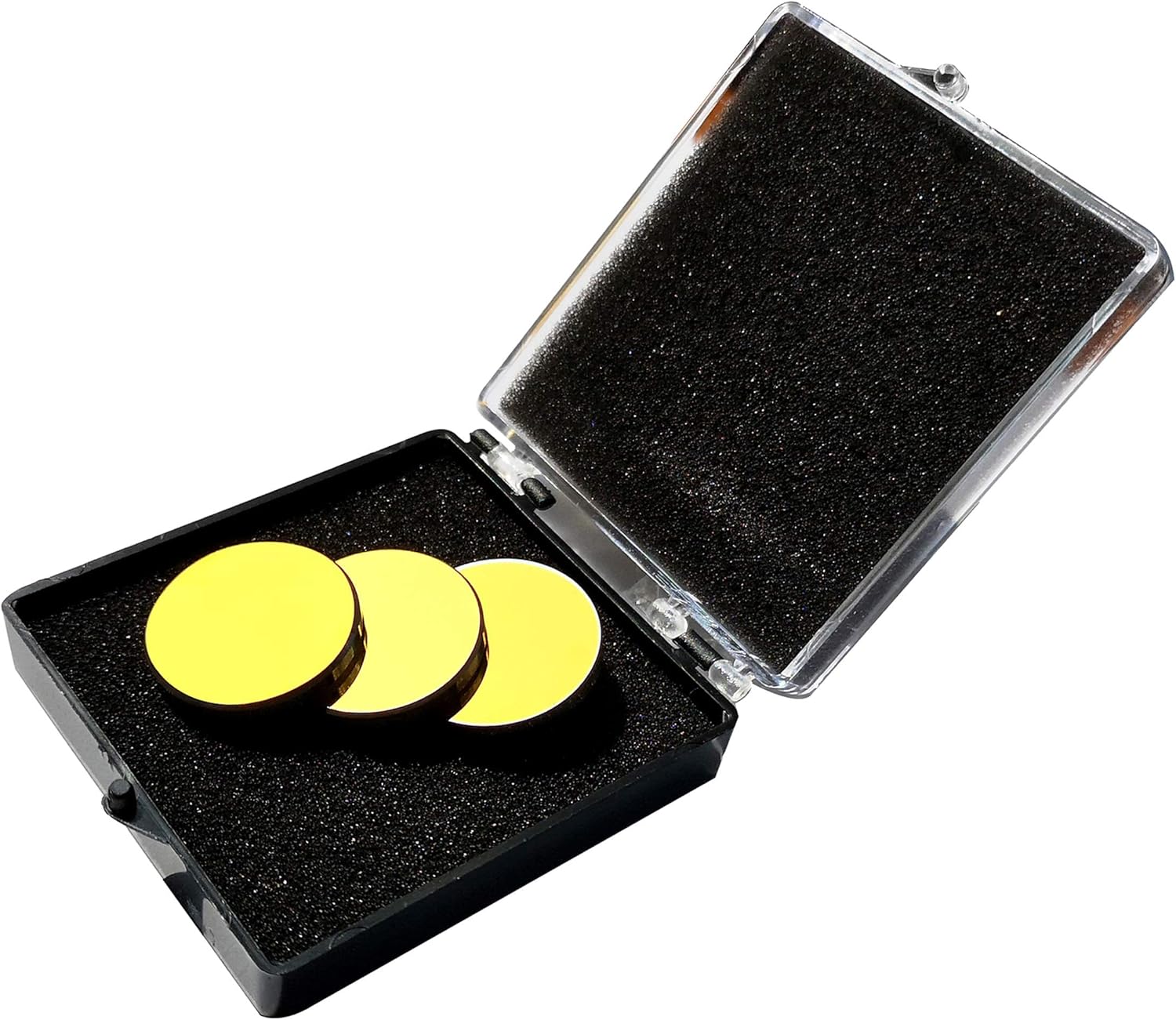
Three 20mm silicon mirrors with gold plating, the size a stock K40's mounts already take. They are the straight upgrade from the K9 glass mirrors many K40s ship with, and there are three so the whole beam path gets done at once.
Most K40s carry 20mm mirrors, and MCWlaser's set is 20mm across and 3mm thick, so it fits the existing mounts without adapters. That makes it the least disruptive optics upgrade you can make. You change the surfaces, not the hardware.
The three mirrors are silicon discs with gold plating, flat, and rated for 40W to 400W machines. MCWlaser quotes reflectivity above 99.8% at 10600nm, the CO2 wavelength, and names these as the replacement for the K9 glass mirrors in the K40 and other 40W machines.
All three mounts on a stock K40 usually take the same 20mm mirror, which is why a three-piece set in one size is the right buy. Confirm it on your own machine before ordering. Remove one retaining ring and measure the old mirror with calipers; it takes two minutes and saves a return.
If your mounts are loose, cracked or out of adjustment range, fix those first. New mirrors in bad mounts will not hold alignment. The K40 upgrade order guide covers when mounts or a new head make more sense than mirrors alone.
| Spec | Value |
|---|---|
| Pieces | 3 mirrors |
| Diameter | 20mm (0.79 in) |
| Thickness | 3mm (0.12 in) |
| Shape | Plane (flat) |
| Substrate | Silicon |
| Coating | Gold plating |
| Reflectivity | Over 99.8% at 10600nm |
| Wavelength | 10.6 µm CO2 laser |
| Power range | 40W to 400W |
| Replaces | K9 glass mirrors in K40 and other 40W machines |
| Model | LM1-SI20x3 |
| Weight | 0.02 kg |
| Colour | Gold |
| In the box | 3 mirrors |
Smoke rises from the cut straight toward the head. The third mirror, just above the lens, sits closest to it and usually fouls first. When cutting power fades, look there and at the lens before you blame the tube.
Take a torch and inspect all three mirrors with the machine unplugged.
If any mirror shows a burn, replace all three from the set. A burnt mirror absorbs heat at the beam spot, and on K9 glass that heat has nowhere to go. It can crack in use and knock the path out of alignment.
| What you see | What to do |
|---|---|
| Light dust | Blow off with a hand air blower |
| Smoke film | One light wipe with isopropyl alcohol on lens tissue |
| Baked film that will not shift | Replace the mirror |
| Burn spot or chipped edge | Replace the mirror |
Make the check a habit rather than a repair. A look at mirror three every few hours of cutting, and at all three once a month, catches film before the beam bakes it into a burn.
Air assist blows smoke away from the head and keeps mirror three and the lens cleaner for longer. A strong exhaust helps the other two. Clean the focus lens whenever you clean mirror three; they foul together.
Reflectivity sounds like a small number to argue over until you multiply it. The beam hits three mirrors before the lens, so each mirror's loss stacks on the one before. Better mirrors return more of the tube's output to the cut.
Run the numbers with the makers' own figures. Three mirrors at MCWlaser's 99.8% pass about 99.4% of the beam to the lens. Three molybdenum mirrors at OMTech's stated 98% pass roughly 94%. A set of tired glass mirrors with burned coatings can pass far less, and the loss grows as they degrade.
| Mirror type | Per-bounce reflectivity | After three bounces |
|---|---|---|
| Gold-plated Si (MCWlaser) | Over 99.8% | About 99.4% |
| Molybdenum (OMTech figure) | Over 98% | About 94% |
| Worn or burnt glass | Falls with damage | Unpredictable |
That is why a mirror swap can make a tired K40 cut again. It does not make a 40W tube stronger. It stops the optics wasting what the tube produces, and that lets you run lower current for the same result, which extends tube life.
Those percentages also explain why a K40 with fresh optics sometimes cuts a sheet that defeated it before. Nothing changed in the tube; less of its output was being turned into heat on the way to the lens.
Silicon is brittle, so handle these with powder-free nitrile gloves, by the rim, and snug the retaining rings only until the mirrors cannot move. After fitting, realign from the tube forward with the alignment walkthrough and wear 10600nm safety glasses for every test pulse.
A 19mm three-piece set of gold-plated silicon mirrors, sold under the CNCOLETECH name, is grouped with MCWlaser's set as an alternative size. It is not interchangeable. A 19mm mirror in a 20mm seat sits loose, tilts under the retaining ring and will not hold alignment.
There are machines with 19mm (three-quarter inch) mirror seats, and for those the 19mm set is the correct part. On a stock K40 with 20mm mounts, stay with the 20mm MCWlaser set.
Against its nearest rival, the CNCOLETECH 20mm Si set, MCWlaser offers the same size, substrate and pack count. CNCOLETECH adds individual vacuum packing and a five-layer gold film. Either suits a stock K40; pick on availability and on how you store spares.
Cleaning is the same for any gold-coated mirror. Blow off loose dust, then wipe once, lightly, with a lens tissue wet with isopropyl alcohol. Never scrub, and never rub in circles. If a mirror needs heavy cleaning every week, the real fix is air assist and better extraction, which the upgrade guide ranks early.
Keep one mirror from the old set as a spare only if it has no burn. A damaged spare is worse than none, because it tempts you to fit it.
Yes, most K40s use 20mm mirrors in 20mm mounts. Measure one of your current mirrors to be sure.
No. A 19mm mirror sits loose in a 20mm seat and will not hold alignment. The 19mm set is for machines with 19mm seats.
The head mirror above the lens. It sits closest to the smoke from the cut and usually fouls first, along with the lens.
Gold-plated silicon reflects more of the beam at each bounce and sheds heat better, so more of the tube's output reaches the cut.