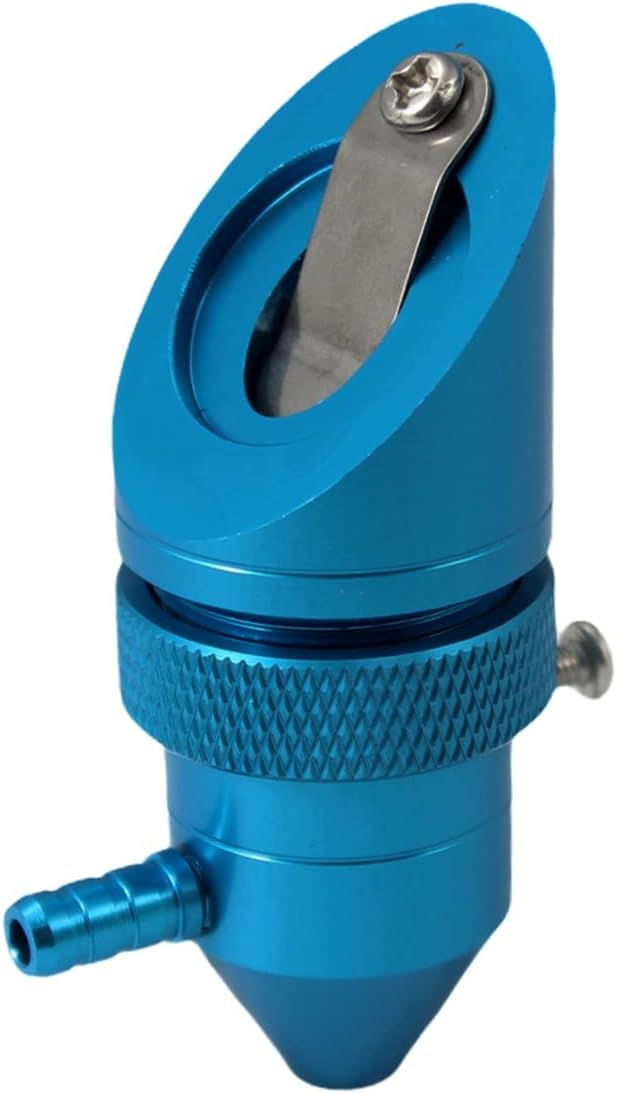
- Upgraded laser head
- 12mm optics
- Air assist built in
A 135W electromagnetic piston pump that pushes a steady stream of air to a CO2 laser head. On a K40 it pairs with an air-assist nozzle to keep the lens clean and the flames down.
A K40 air assist does not need shop-compressor pressure. It needs a steady, clean stream through a small cone under the lens, all job long. That stream clears smoke from the beam path, keeps resin and soot off the focus lens and knocks down the flame that follows the beam through plywood.
The Cloudray 135W is built for that kind of work. It is an electromagnetic linear piston pump: a magnet drives the piston back and forth in a straight line, with no crank, no belt and no oil sump to spit mist at your optics. The body is cast ZL102 aluminum alloy shaped to shed heat, and the cylinder and piston use a wear-resistant material Cloudray calls SF3.
Cloudray also sells it as an aerator for aquariums, ponds, hydroponics and compost tea. That tells you the duty it was built for: running for hours at modest pressure, which is the same pattern a laser air assist asks for.
Three jobs where it pays off on a K40:
The pump is only half the job. A stock K40 head has nowhere for the air to go, so fit an air-assist head before anything else.
| Spec | Value |
|---|---|
| Type | Electromagnetic linear piston air pump |
| Maker | Cloudray |
| Rated power | 135W |
| Voltage | 110V |
| Frequency | 60Hz |
| Air flow capacity | 120 L/min |
| Pumping capacity (second figure) | 70 L/min |
| Noise | 69 dB |
| Housing | ZL102 aluminum alloy, streamlined for heat dissipation |
| Cylinder and piston | SF3 wear-resistant material |
| Motor | Electromagnetic, straight-line reciprocating motion |
| Duty rating | Up to 1 year of continuous service |
| Power source | Corded electric |
| Weight | 10.3 lb |
| Laser use | Air assist for CO2 laser cutting and engraving |
| Other uses | Aquarium, pond, hydroponics, compost tea aeration |
Cloudray quotes two airflow numbers for this pump: 120 L/min as the air flow capacity, and 70 L/min as the pumping capacity in the description. Both describe the same 135W unit. Plan your setup around the lower one and treat anything above it as headroom.
The reason is simple physics. A pump's rated flow is measured with nothing restricting the outlet. Every metre of hose, every valve and the small bore of the nozzle add back pressure, and flow at the nozzle drops as that resistance rises. On a K40, the nozzle is the tightest point in the whole line.
| Figure | What it describes | How to use it |
|---|---|---|
| 120 L/min | Headline air flow capacity | Best case, open outlet |
| 70 L/min | Pumping capacity | A safer planning number |
| 69 dB | Noise rating | Place it away from the operator |
What moves the real flow at the head:
If the stream at the nozzle feels weak, the fix is almost always in the line, not a bigger pump. A pump parked in the next room is possible, but every extra metre of hose costs flow.
Either figure is plenty for a K40 nozzle. The point is to keep the line open so the pump can deliver what it makes.
Set the pump on the floor or a shelf beside the laser, not on the laser lid. At 69 dB it hums like a busy aquarium pump, and a rubber mat under it stops the buzz travelling into the bench. Leave space around the aluminum body so it can shed heat.
Then plumb it in this order:
Keep the hose clear of the tube bay and the high-voltage lead at the tube's anode end. Route it along the front of the gantry, where you can see it and where it cannot rub on anything live.
After fitting any new head, check the beam still lands centred on the lens; the K40 alignment guide walks through the mirror checks. First-time owners should also run through the setup steps in how to use a K40 laser, especially the exhaust and glasses.
Cloudray rates this pump for up to a year of continuous service, and a K40 in a home shop runs a small share of that. Clean intake air and cool running decide most of its life. Neglect either and the piston wears early.
A short maintenance routine:
Keep a spare length of silicone tube on the shelf. The section near the head gets baked by smoke and reflected heat, and a split hose robs the nozzle long before the pump weakens.
Start at the wall socket. The pump runs on 110V at 60Hz, so it suits North American mains and not a 230V 50Hz shop. It weighs 10.3 pounds, so it will not walk across a shelf, but it still wants a stable spot.
How it sits among the options: the OMTech smart airway module adds automatic high and low pressure, but OMTech rules out the K40, so it is not a choice here. For a K40 the Cloudray pump plus a nozzle head is the straightforward path, and air assist earns an early slot in the K40 upgrade order. If you are still choosing a machine, the OMTech K40+ has air assist built in.
Yes for air assist. Even its lower quoted figure of 70 L/min is plenty for a K40 nozzle, as long as the hose is short and free of kinks.
Cloudray suggests 5x8mm silicone tube for its K40 head's 5.3mm barb. Measure the pump outlet and use a step adapter if it is a different size.
It is an electromagnetic linear piston pump with no oil sump, so there is no oil to filter. Keep the intake clean and away from sawdust.
No. It is built for 110V at 60Hz.
Cloudray rates it at 69 dB. Set it on a rubber mat off the laser and bench to cut the hum.