- Replacement optics
- 20mm optics
- Fits K40-size CO2 lasers
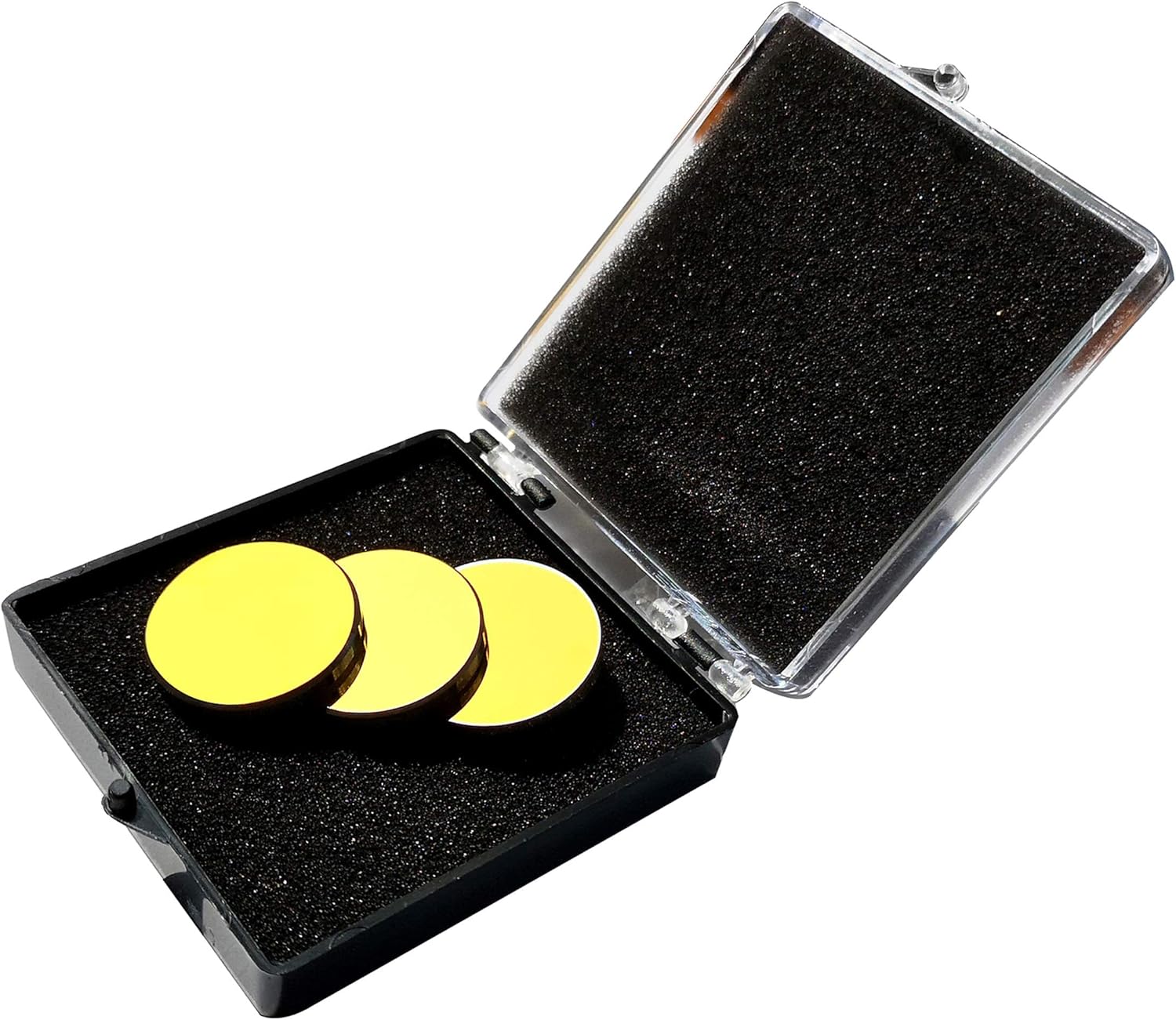
A set of three 25mm silicon mirrors with a gold coating, enough to replace every mirror in a K40's beam path at once. They are larger than the K40's usual 20mm mirrors, so they suit machines with 25mm mounts or owners upgrading the mounts too.
A K40 bends its beam three times: at the fixed mirror by the tube, at the mirror on the gantry, and at the mirror in the head above the lens. Cloudray's set gives you three matched 25mm mirrors, 3mm thick, so every bend gets a fresh surface at the same time.
Replacing all three together is the smart way to do it. A dirty or burnt mirror anywhere in the path wastes power and can hide an alignment problem. Swapping one at a time means three separate alignment jobs, and it leaves you guessing which surface was the weak one.
Cloudray pitches the set both at larger machines and as a K40 mirror upgrade. Both are fair, with one condition: the mounts have to take a 25mm mirror. On the K40, that is the question that decides everything else.
For the order to tackle optics against other upgrades, see the K40 upgrade guide.
| Spec | Value |
|---|---|
| Pieces | 3 mirrors |
| Diameter | 25mm (0.98 in) |
| Thickness | 3mm (0.12 in) |
| Substrate | Silicon (Si) |
| Coating | Gold |
| Shape | Plane (flat) |
| Reflectivity | Over 99.2% at 10600nm |
| Wavelength | 10.6 µm CO2 laser |
| Power range | Stated for 60W to 400W machines; used on K40s too |
| Model | Gold Coated Si D25 T3 |
| Weight | 20 g |
| In the box | 3 Cloudray mirrors |
| Use | Beam-path mirrors in CO2 engravers and cutters |
Most K40s leave the factory with 20mm mirrors in 20mm holders. A 25mm mirror will not drop into those holders, and it will not be held square by any amount of packing. Measure before you order.
Take the retaining ring off one mirror and check with calipers. The mirror nut tool that fits K40 mounts makes this quicker and safer than pliers.
| Your mounts | Right choice |
|---|---|
| 20mm (typical stock K40) | A 20mm set, such as MCWlaser's or CNCOLETECH's 20mm Si |
| 25mm (aftermarket or larger machines) | This Cloudray set fits directly |
| Mixed or unknown | Measure each of the three; they are not always the same |
A larger mirror gives a bigger target, which helps on long beam paths where the beam wanders or spreads. On a K40's short path, that margin matters less, so do not change your mounts only to use 25mm mirrors. Change them if your stock mounts are loose, cracked or out of adjustment range, and choose the 25mm size while you are at it.
If you stay with 20mm, the MCWlaser 20mm Si set is the like-for-like upgrade.
Every mirror material is a trade. Silicon conducts heat well and is light, and with a gold coat it reflects the CO2 wavelength strongly. The coating is the part to protect, because it is thinner and softer than an uncoated metal mirror.
Here is how the common K40 mirror types compare.
| Material | Strength | Weakness |
|---|---|---|
| Gold-coated silicon (this set) | High reflectivity, light, sheds heat well | Brittle disc, coating scratches if scrubbed |
| Molybdenum, uncoated | Very hard surface, tolerates firm cleaning | Lower reflectivity, heavier |
| K9 glass, gold coated | Cheapest | Glass holds heat; coating burns off sooner |
| Copper | Excellent heat conduction for high power | Soft surface, tarnishes and scratches |
For a K40 that you keep reasonably clean with air assist and a working exhaust, gold-coated silicon is the upgrade most owners choose over stock glass. If your machine lives in a dusty shed and the mirrors fog weekly, uncoated molybdenum survives the extra cleaning better.
Clean these gently.
Inspect them on a schedule rather than waiting for weak cuts. A quick look at each mirror under a torch every few hours of cutting will show smoke film and spatter before they bake on. Baked residue under the beam turns into burn spots that no cleaning removes.
Silicon discs are brittle. Do not overtighten the retaining ring, and never drop a mirror on a hard bench; a chipped edge can crack under heat.
Swapping a mirror always moves the beam a little, even with the same mount. Plan a full alignment from the tube forward, and start with the first mirror because every later mirror depends on it.
The K40 alignment walkthrough covers each stage with photos of the marks you want. Wear 10600nm safety glasses for every test pulse, and keep your hands out of the path whenever the tube can fire.
Once aligned, run a test cut on scrap at your usual settings and compare it with a cut from before the swap. Fresh mirrors often let you cut the same sheet a little faster or at a lower current. Take the gain as lower current where you can, because the tube lasts longer that way.
Against the other gold-on-silicon sets, Cloudray's is the 25mm pick. CNCOLETECH makes a 25mm Si set too, plus 20mm versions in silicon and K9 glass. BLUETIMES offers a 30mm size for industrial mounts. MCWlaser's 20mm set fits stock K40 mounts directly.
Usually not. Most K40s use 20mm mirrors in 20mm mounts, so you need 25mm mounts first. Measure your existing mirrors with calipers first.
Three: one by the tube, one on the gantry and one in the head above the lens. This set covers all three.
Yes, gently: blow off dust, then one light wipe with a tissue wet with isopropyl alcohol. Never scrub or rub in circles.
Gold-coated silicon reflects more of the beam and sheds heat well. Molybdenum reflects a little less but has a harder surface that tolerates rough cleaning.