- Replacement optics
- 18mm optics
- Fits the K40
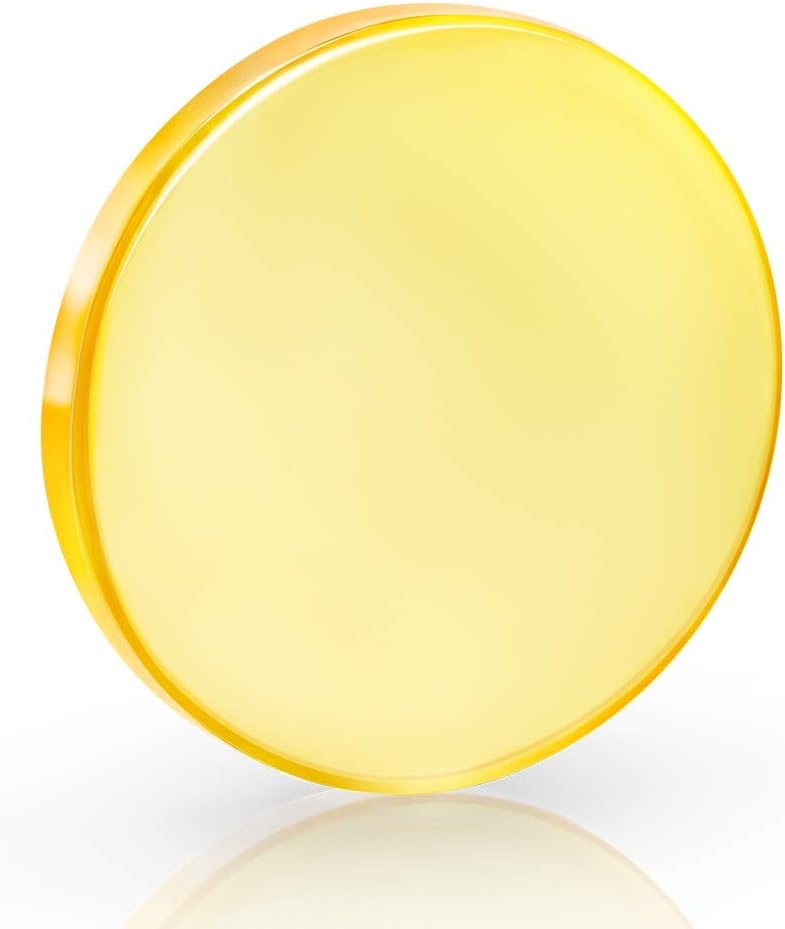
An 18mm plano-convex lens in PVD zinc selenide with a short 38.1mm (1.5 in) focal length. It focuses to a smaller spot than the K40's stock 50.8mm lens, which sharpens fine engraving, and TEN-HIGH also makes it in 76.2mm and 101.6mm.
A shorter focal length brings the beam to a smaller point. At 38.1mm, TEN-HIGH's lens focuses about a quarter tighter than the K40's stock 50.8mm, all else equal. That is the whole reason to fit one: crisper small text, finer photo dots and thinner vector lines.
The trade is depth. The zone where the spot stays tight shrinks roughly with the square of the focal length, so a 38.1mm lens holds focus over a little over half the depth of a 50.8mm lens. On flat, thin work that does not matter. On thick sheet or warped wood, it does.
| Job | 38.1mm (this lens) | 50.8mm (stock) |
|---|---|---|
| Small text and photo engraving | Sharper | Good |
| Card, paper, thin veneer | Clean, narrow kerf | Good |
| 3mm plywood or acrylic cutting | Workable, with some taper | Better balance |
| Thicker sheet | Tapered, slower | Better; 63.5mm better still |
| Warped or uneven material | Unforgiving | More forgiving |
Those ratios come from basic beam optics and assume the same beam entering the lens. Real results also depend on your tube's beam quality and how square the mirrors are, so a poorly aligned K40 will not show the full gain. Align first, then judge the lens.
So treat this as an engraving lens. If your K40 does mostly detailed engraving, it can live in the head full time. If you cut as much as you engrave, keep your 50.8mm lens and swap as the job demands.
The materials guide covers what a 40W K40 handles at each thickness.
| Spec | Value |
|---|---|
| Diameter | 18mm (0.71 in) |
| Focal length | 38.1mm (1.5 in) |
| Thickness | 2.2mm (0.09 in) |
| Material | PVD ZnSe |
| Shape | Plano-convex |
| Transmittance | 99.5% or better |
| Coating | Double-sided solid coating |
| Surface | Precision sliced, ground and polished |
| Wavelength | 10.6 µm CO2 laser |
| Laser power | 30W to 100W |
| In the box | 1 lens |
| Other focal lengths | 76.2mm (3 in) and 101.6mm (4 in), both 18mm |
| Use | CO2 laser engraving and cutting machines |
Swap a 50.8mm lens for this 38.1mm one and the focal point moves 12.7mm closer to the lens. The head stays put, so the work has to come up. That is easy on an adjustable bed and awkward on a stock clamp bed.
Set focus properly rather than by guesswork.
Now check the nozzle. Many K40 air-assist heads have a cone that reaches well below the lens. With a short focal length, the gap between nozzle tip and focus point shrinks, and on some heads it may leave too little room for thicker work or warped sheet. Measure your nozzle's length against the new focus height before you order.
A Z table makes lens swaps simple, because you set the height by the gauge each time. Lightobject's power Z table is one route, and the alignment and focus guide covers ramp tests in more detail.
TEN-HIGH makes this lens in PVD zinc selenide, rated for 30W to 100W. PVD is the cheaper grade. It focuses the same way as CVD, but it absorbs a little more of the beam as heat, so it tolerates contamination and long runs less well.
On a 40W K40 that is a reasonable trade, provided you keep the lens clean. A film of smoke on a PVD lens heats it faster than the same film on CVD, and heat is what cracks lenses and burns coatings. Air assist earns its place here.
Handle every ZnSe lens as a hazardous part. Zinc selenide is toxic and soft. Wear powder-free nitrile gloves or finger cots and hold the lens only by its rim.
TEN-HIGH makes the same 18mm PVD lens in 76.2mm (3 in) and 101.6mm (4 in) focal lengths. Those push the focus 25.4mm and 50.8mm further from the lens than stock. On most K40s that means major bed work.
A K40's cabinet is shallow. The stock clamp bed usually has to come out even for modest drops, and a 50.8mm drop may need a cut-out floor, a motorised Z table with long travel, or a raised head. Longer lenses also spread the spot, which on a 40W tube cuts energy density. They suit larger machines with more power and more room better than a K40.
Against rival short-focus lenses, the Mssoomm 18mm 38.1mm lens is the direct alternative in CVD grade, with a wider 30W to 250W rating and a 2mm thickness. If your head takes 20mm, Cloudray's 20mm CVD lens keeps the stock 50.8mm focus with a meniscus shape. For thicker cutting, CNCOLETECH's 63.5mm lens is the sensible middle step before going to 76.2mm.
Many K40 owners keep two lenses: a short one for engraving and the stock 50.8mm for cutting. With a focus gauge for each, a swap takes a few minutes. Label the lenses' cases, because two 18mm lenses look identical on the bench.
Fine engraving and thin materials. It focuses to a smaller spot than the stock 50.8mm lens, at the cost of a shallower focus zone.
Yes. The focus sits about 12.7mm closer to the lens than with a 50.8mm lens, so raise the work and run a ramp test to confirm.
Yes, with air assist and regular cleaning. It absorbs slightly more of the beam than CVD, so it tolerates smoke and long runs less well.
Only with major bed changes. It moves the focus 50.8mm lower than stock, which most K40 cabinets cannot accommodate without modification.