- Replacement optics
- 20mm optics
- Fits K40-size CO2 lasers
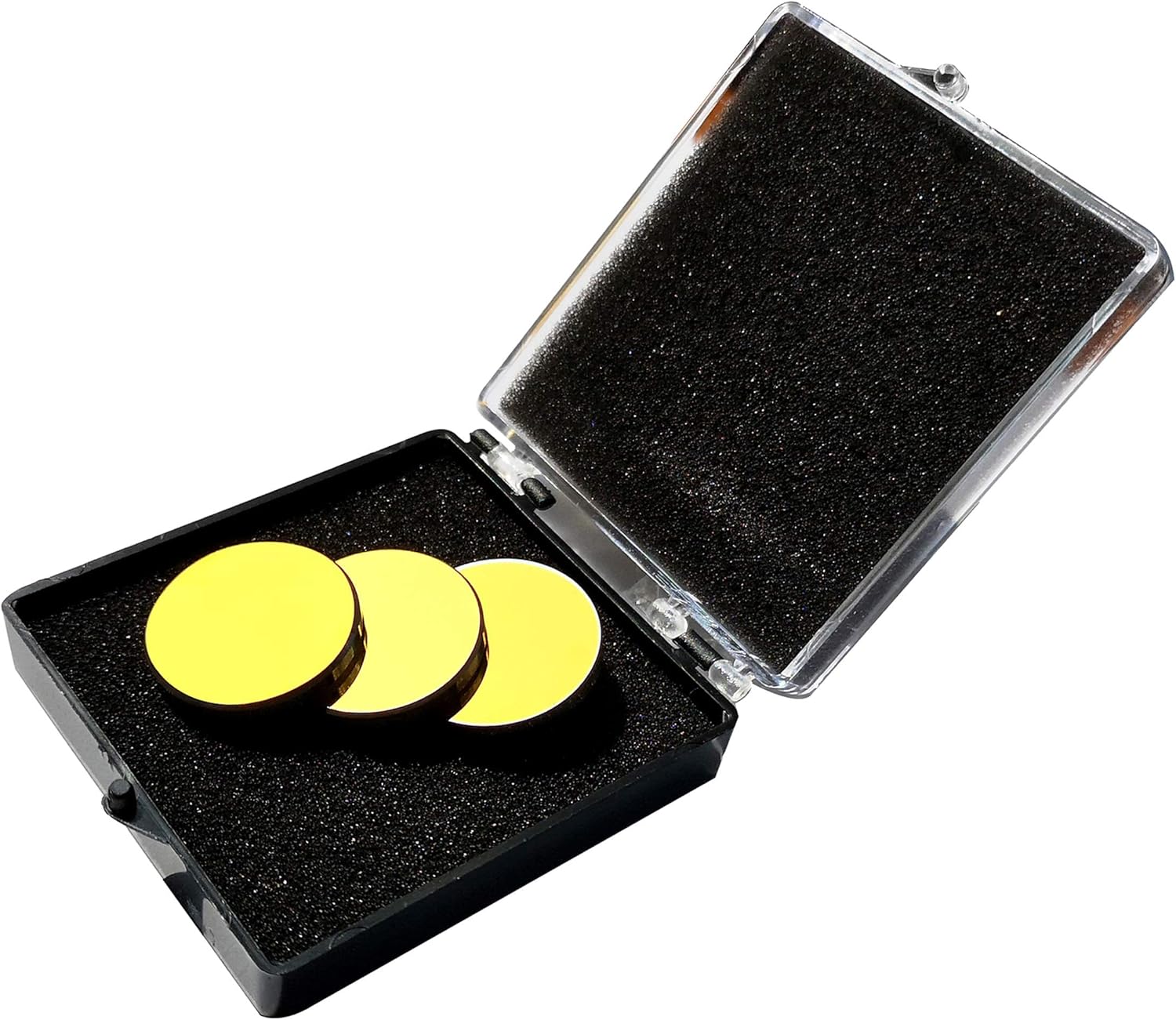
Three gold-plated silicon mirrors in the 3/4-inch size, vacuum sealed and rated up to 300W. They replace the cheap glass mirrors many K40s ship with, provided your mounts suit a 19.05mm mirror.
These are 19.05mm mirrors, which is the 3/4-inch size, not the 20mm size most K40 mounts are machined for. That single millimetre decides whether this set is a clean fit or a compromise. Put calipers on your current mirror before you order.
Here is what the size difference means at the bench. A flat mirror steers the beam by its tilt, not by where it sits sideways in the seat. So a 19.05mm mirror in a 20mm seat still reflects correctly, as long as it sits flat against the seat face and the retaining ring clamps it evenly.
The risk with a loose fit is tilt. If the ring bears on one edge, the mirror leans, and the beam walks off its target further down the path. That shows up as a spot that moves between the near and far corners of the bed.
If your seats are 20mm, a 20mm set such as the MCWlaser gold silicon mirrors seats without play and saves you the fuss. Buy the 3/4-inch set when your mounts were made for it, or when you already know the fit works in your machine.
The mirrors ship vacuum sealed, one pack of three. Leave them sealed until you are ready to fit them, since bare gold picks up handling marks and dust quickly.
| Spec | Value |
|---|---|
| Diameter | 19.05mm (3/4 in) |
| Thickness | 3mm (0.12 in) |
| Shape | Plane (flat) |
| Substrate | Silicon |
| Reflective coating | Gold, 5 layers |
| Reflectivity | Up to 99.3% at 10,600nm |
| Power range | 40–300W CO2 |
| Mirrors per pack | 3 |
| Weight per mirror | 6g |
| Packaging | Vacuum sealed |
| Mirror dimensions | 0.75 × 0.75 × 0.12 in |
| Handling | Rubber gloves during fitting |
| Cleaning | Ethanol swab, then acetone swab |
Many K40s leave the factory with gold-coated K9 glass mirrors. Glass is cheap and easy to polish flat, but it conducts heat poorly. A spot of dirt under the beam heats up, the coating around it degrades, and the mirror starts eating power.
Silicon handles that heat far better, which is why gold-plated silicon is the usual first optics upgrade. XUNKUANER rates this set for 40W to 300W and quotes reflectivity up to 99.3% at the CO2 wavelength of 10,600nm. The 5-layer gold plating is there to resist peeling.
| Mirror type | Strength | Weak spot |
|---|---|---|
| K9 glass, gold coated | Cheap, common as stock | Poor heat transfer, coating burns |
| Silicon, gold plated (this set) | High reflectivity, sheds heat | Soft coating, careful cleaning |
| Molybdenum, bare | Very hard, tolerates scrubbing | Lower reflectivity |
Across three mirrors, a rated 99.3% per bounce leaves roughly 97.9% of the beam on paper. That arithmetic ignores dirt and alignment, which in a working shop cost more than the rated figure.
How do you know your stock mirrors are glass? Look at the edge. K9 glass shows a clear or greenish edge under the gold, while silicon is grey and opaque. Tip one toward a light and a glass mirror shows its body through the edge; silicon never does.
Fitting the new set is quick, but do it in order:
Follow the alignment guide to realign, one mirror at a time.
XUNKUANER gives its own cleaning routine for these mirrors, and it is sound. Wear rubber gloves when fitting, so the coating never meets bare skin. When dust or condensation lands on the face, clean it in two passes.
Use light pressure only. Gold is soft, and a swab that carries grit leaves fine scratches that scatter the beam. If the film does not lift after two gentle passes, the coating is probably burned, and no solvent will bring it back.
Condensation is worth a second look. If mirrors fog up, the cooling water may be colder than the room's dew point, which also risks water on the tube. Keep coolant near room temperature rather than chilling it hard.
Gold silicon three-packs are everywhere, and most differ only in size and stated reflectivity. The XUNKUANER set stands out for its 3/4-inch diameter, a clear cleaning procedure and vacuum-sealed packing. The size is also its limit.
Weigh it against the sizes your machine can take:
With the machine unplugged, go through this list:
If your mounts turn out to be 20mm, weigh the fuss of centring a smaller mirror against ordering the right size. A mirror that tilts under its ring costs more evenings than it saves.
A mirror swap is a good moment for a wider service. Clean the lens, check the air-assist line, and look over the tube's water flow. The upgrade guide ranks what to fix next, and how to use a K40 has the safety checklist that should come before every job.
Silicon mirrors last a long time in a clean machine. In a smoky one, even the best coating fails early, so fix the exhaust and air assist alongside the optics. Keep a spare mirror in the drawer, because the one in the head usually fails first.
They fit mounts made for 3/4-inch mirrors directly. In a 20mm seat they work but have play, so centre them and tighten the ring evenly to avoid tilt.
Blow off dust, then wipe once with an ethanol-dampened swab and follow with an acetone swab. Use light pressure and let the solvent evaporate before firing.
Gold-plated silicon sheds heat far better than K9 glass, so the coating survives longer under the beam. That is why it is a common first optics upgrade.
XUNKUANER rates them for 40W to 300W CO2 lasers, which covers any K40.